How Planex works, start to finish.
Planex turns a goal written as one sentence into a realistic plan with dated milestones, fits it into the hours you actually have, and adjusts it every week. This page is the whole mechanism, in order.
In short: you type a goal, answer a few tap questions, and Planex writes a plan of dated milestones, tasks and habits. A separate AI review scores it for realism and plans judged unrealistic are revised, and the plan is scheduled into one Today timeline with reminders. Every Sunday, on Pro, it rewrites the next week from what you actually did. Planex is an Android app. It is in closed testing on Google Play and not yet publicly downloadable; leave an email to hear when it is. There is no iPhone version yet.
1. You say the goal
One sentence, in your own words: run 10 km without stopping by March, pass the exam while working full time, save $20,000 this year. Planex then asks a few questions, and only the ones it needs: how hard you want to go, where you are starting from, and the time you really have. There is no form to fill in and no account to make.
2. It writes the plan
The plan is a structured route, not a wall of text:
- Milestones: measurable outcomes with target dates, so you can tell whether you reached one.
- Tasks: one-off actions with an estimated duration and, where it matters, a due date.
- Habits: recurring sessions with a frequency, a duration and a time of day.
- Assumptions: what Planex guessed about you, written down so you can correct it.
A plan is a dated map of every milestone. The phase you are in is built in full; later phases are written in the background as they approach, from what you actually did in the phases before. A plan that runs for a year does not pretend to know what week 40 looks like on day one.
3. It is checked for realism
A separate AI review pass reads every plan against your hours, your starting point and your deadline, and scores it for realism. The score is shown on your plan. A plan judged unrealistic is revised once and scored again before the finished plan reaches you; a brand-new plan started while you are on Pro is also revised when it scores under 70 out of 100. You can read the outline of milestones while this check runs. The reviewer's notes are specific: five runs does not fit three free evenings, two kilometres to ten in six weeks is how beginners get injured.
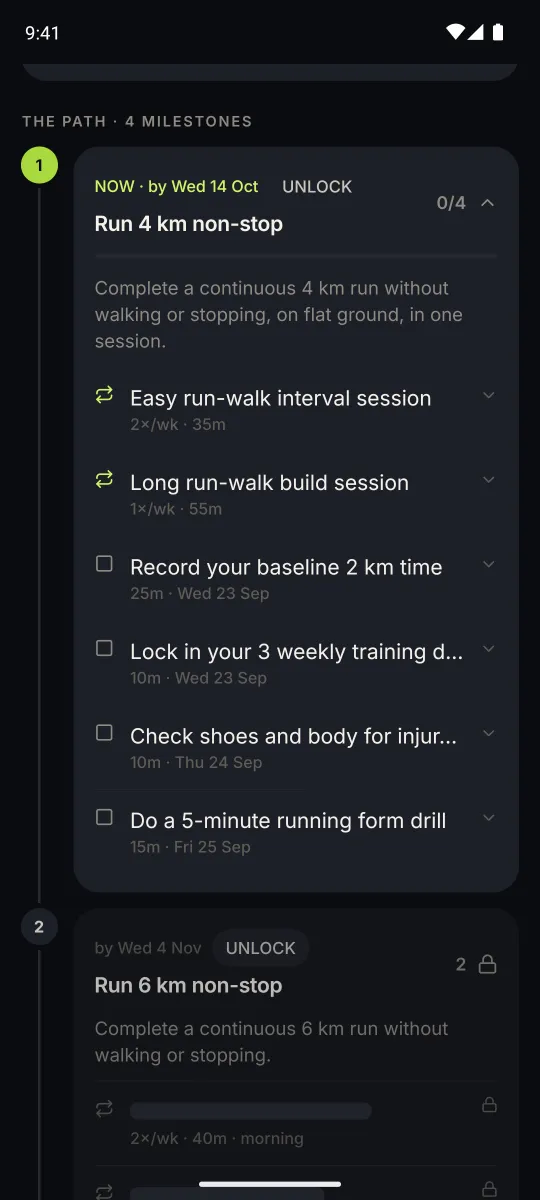
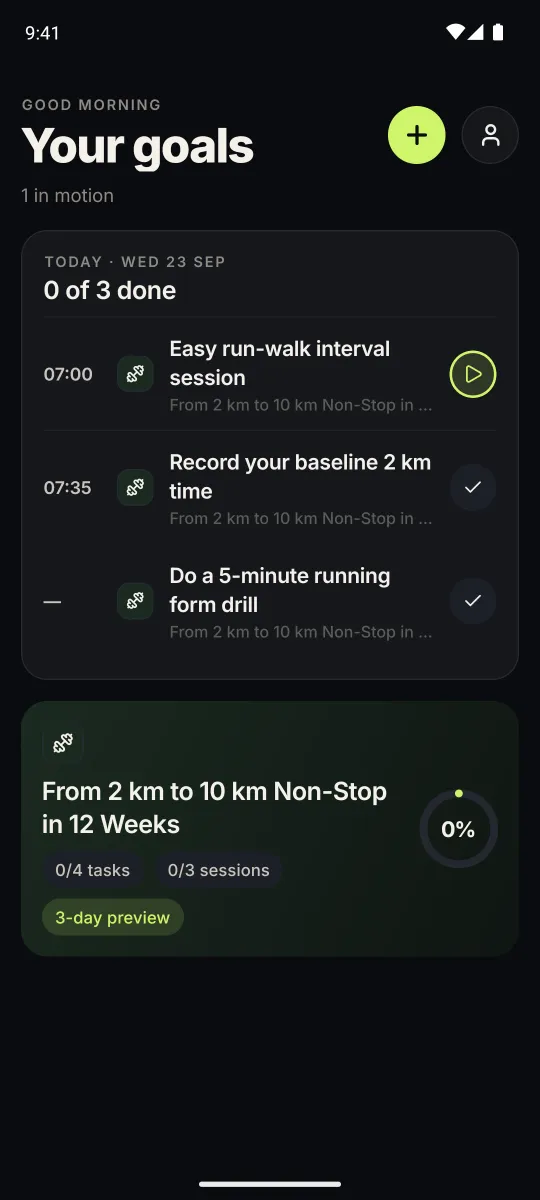
Screenshots from the Android app (dark mode), from a free 3-day preview of a 10K plan.
4. Today
You do not read the plan every day; you read Today. Every active goal's tasks and habits are merged into one timeline with real times, fitted around the day shape you gave Planex: when you wake, when you are busy, when you work best. A handful of things, not thirty.
- Reminders arrive at the time of the session, with Done and Snooze on the notification itself. They work even when you don't open the app.
- A home-screen widget (Android) shows the next action.
- Watch how: tasks and habits that need technique carry a short clip or a step card, right where you do them.
- Proof: a timer for sessions, and optional photo proof when you tick something off (photo proof is Pro).
5. Every Sunday, it reads your week (Pro)
You tick things off as you go. With Pro, on Sunday Planex looks at what actually happened, not what was scheduled, and rewrites the week ahead: smaller after a rough week, bigger when you are ahead, sessions moved to the times you actually kept them. A missed day does not pile onto the next one and does not mean starting over. The finish date holds unless it cannot, and then Planex says so.
When life changes in a bigger way, a new job, an injury, a moved exam date, you tell Planex once and, on Pro, the plan re-routes from where you are. After a rough stretch, Pro lets you restart smaller instead of quitting.
6. What is free and what is Pro
Your first goal starts with the whole route and the first three days planned with real times, free, with no card. The free preview is one goal, once. You see whether it fits your life, then decide. Planex Pro plans every day after that, runs the Sunday review, lets you re-route when something changes, holds up to three goals at once, and adds camera scans and photo proof. It costs $9.99 a month or $49.99 a year through Google Play. The pricing page has the full comparison.
7. Your data
What you tell Planex is used to run the app and to build and adjust your plan; Planex also keeps basic usage counts, such as how many people use it each day. There are no ads and nothing is sold. You can delete everything from inside the app or at myplanex.app/delete. Plans you choose to share get a public read-only page that you can turn off at any time; nothing is public unless you share it. The privacy policy lists every piece of data and why.
8. What Planex is not
Planex is a planning coach. It is not a medical device, it does not diagnose or treat anything, and it is not a financial or legal adviser. For health goals it plans routines and habits; for money goals it plans savings and income moves; for anything with real stakes, the plan will tell you when to see a professional, and you should.
Questions
What is Planex?
Planex is an Android app that turns a goal written as one sentence into a realistic, dated plan, schedules that plan into the hours you actually have, reminds you at the right moments, and on Pro rewrites the week ahead every Sunday from what really happened.
How is Planex different from a to-do list or habit tracker?
A to-do list holds what you typed. Planex writes the plan itself from your goal and your constraints, checks it for realism, and changes it as you go. The tasks and habits exist because the plan needs them, and they move when your week does. Planex compared with other ways to plan.
Is the plan written by AI?
Yes. A planning model writes it from your answers. A separate AI review pass then scores it for realism against your hours, starting point and deadline. A plan judged unrealistic is revised once and scored again before the finished plan reaches you; a brand-new plan started while you are on Pro is also revised if it scores under 70 out of 100. The score is shown on your plan, and you can read the outline of milestones while the check runs. Planex is a planning coach, not a doctor, lawyer or financial adviser.
How long does a plan take to build?
It is not instant: writing and reviewing a plan are several AI steps. While they run, Planex gives you a first step to start on and shows the outline of milestones. Later phases are written in the background as they approach.
Do I need an account?
No. Planex works from the moment you open it, with no sign-up or password. To move to a new phone, the app gives you a one-time code to enter on the new one.
Which phones does Planex run on?
Planex is an Android app. It is in closed testing on Google Play and not yet publicly downloadable; leave an email to hear when it is. There is no iPhone version yet.
What does Planex cost?
The whole route and the first 3 days of your first goal are free, with no card. Planex Pro, which plans every day after that and runs the Sunday review, is $9.99 a month or $49.99 a year, billed through Google Play. Prices may show in your local currency.
Try it on your goal
Say it in one sentence. Planex gives you a first step to start on while it builds the route.
Updated by Planex. Corrections: akr3ch@icloud.com.